
Breast Lift and Augmentation (Augmentation Mastopexy)
A breast lift and augmentation, or augmentation mastopexy, corrects sagging and restores lost breast volume in a single procedure. We remove excess skin, lift the nipple and areola, and add volume with high-quality Motiva implants, optionally with the special tissue-preserving Motiva Preservé™ technique or the addition of the patient's own fat.

long-lasting, but subject to natural ageing
approximately 2–3 hours
approximately 1–2 weeks
About the Procedure
Pregnancy, breastfeeding, significant weight loss, fluctuations in body weight and natural ageing can cause the breasts to lose volume, firmness and a youthful shape. The skin stretches, the breasts drop, and the upper part of the breast becomes less full or empty.
When we want to correct sagging and restore lost volume at the same time, a breast lift can be combined with augmentation. This procedure is called augmentation mastopexy.
During the procedure, we remove excess skin, reshape the breast's own tissue, lift the nipple and areola, and add volume with implants. If needed, the result can be further refined with a transfer of the patient's own fat.
The goal of the procedure is fuller, firmer and lifted breasts that are in proportion with the patient's body and wishes.
In selected patients, the augmentation part of an augmentation mastopexy can also be performed with the tissue-sparing Preservé™ by Motiva technique, which aims to preserve the breast's natural supporting structures as much as possible.
What Can Be Achieved with a Breast Lift and Augmentation?
An augmentation mastopexy can help us:
- lift sagging breasts,
- restore lost volume and enhance fullness in the upper part of the breast,
- increase breast size,
- improve projection and roundness,
- reduce a stretched areola and reposition the nipple to a more suitable position,
- improve asymmetry between the breasts and create a more proportionate relationship between the breasts and the body.
When planning the procedure, we don't just choose implant size — we also take into account the width of the chest, the amount of the patient's own tissue, skin quality, the degree of sagging and the desired breast shape.
Who Is a Suitable Candidate for Augmentation Mastopexy?
The procedure is particularly suitable for patients whose breasts are sagging and, at the same time, empty or less full.
A suitable candidate:
- has dropped or sagging breasts and an empty upper breast,
- has lost volume after pregnancy, breastfeeding or weight loss,
- wants larger as well as more lifted breasts,
- has a nipple below the level of the breast crease or pointing downward, as well as a stretched or enlarged areola,
- notices asymmetry between the breasts,
- has a stable body weight, is in good general health and has realistic expectations regarding the result and scarring.
If you are planning a pregnancy in the near future, it generally makes sense to postpone the procedure, since pregnancy and breastfeeding can once again affect breast volume, skin and position.
Why Isn't an Implant Alone Always Enough?
A breast implant increases volume and improves breast shape, but it cannot adequately correct significant sagging on its own.
If the nipple sits below the breast crease or there is too much skin, an oversized implant places additional strain on the breast without lifting it properly. In such cases, the excess skin must be removed, the tissue reshaped and the nipple repositioned higher.
An augmentation mastopexy therefore solves two separate problems:
- the lift corrects the position and sagging of the breast
- the implant restores volume and improves projection and fullness.
How Is a Breast Lift and Augmentation Performed?
The procedure is usually performed under general anaesthesia and takes approximately two to three hours, depending on the degree of sagging, the chosen technique and whether the patient's own fat is used.
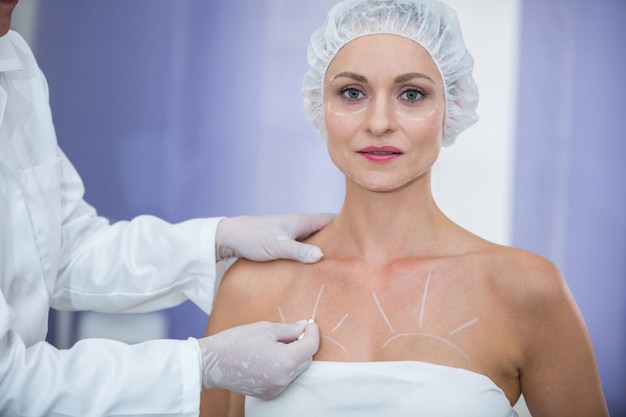
Before surgery, we precisely measure and mark:
- the new nipple position
- the planned incision lines
- the breast crease
- the implant position
- the planned breast shape.
During surgery, we first prepare the pocket for the implant and check how the chosen volume affects the shape of the breast. We then remove the excess skin, reshape the breast's own tissue, and lift the nipple and areola.
The breast shape, implant size and the amount of tissue removed are coordinated throughout the procedure, since the lift and the augmentation must together create a single, natural-looking result.
Choosing Breast Implants
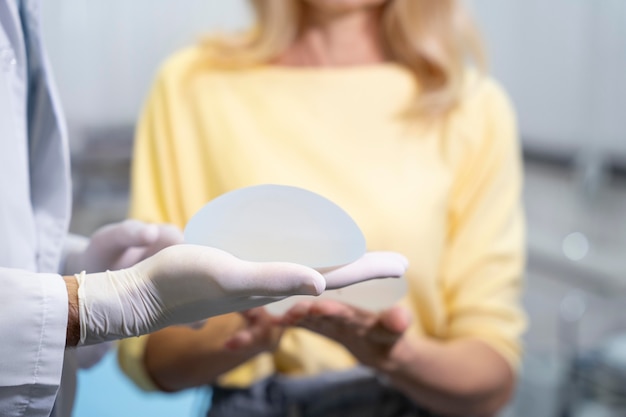
Implant size and shape are always chosen individually. The same implant can produce a completely different result in two patients, because the appearance depends on chest anatomy, tissue quality and breast position.
When choosing an implant, we take into account:
- the width of the chest and breast
- the amount of the patient's own tissue
- the thickness of the skin and subcutaneous layer
- the degree of sagging
- the desired size
- the desired fullness of the upper breast
- the balance between a natural and a more pronounced look.
In augmentation mastopexy, we often choose a somewhat more moderate volume than in standalone breast augmentation with Motiva® implants. An oversized implant can place additional strain on the skin and tissue and affect the long-term stability of the result.
At Klinika Višnjar, we use high-quality Motiva implants, and the final choice of model, projection and size is made together with the patient based on measurements and the desired result.
Breast Lift and Augmentation with the Preservé™ Technique
In selected candidates, the augmentation part of an augmentation mastopexy can also be performed with the tissue-sparing, structure-preserving Motiva Preservé™ technique.
In a classic augmentation, the pocket for the implant is usually created through surgical dissection of the tissue. With the Preservé™ technique, we use specially designed instruments that gradually and in a controlled way separate the tissue layers while preserving the breast's natural supporting structures as much as possible.
A soft, ergonomic Motiva SmoothSilk® Ergonomix2® implant is then placed into the prepared pocket. The goal of the technique is to reduce unnecessary tissue damage, preserve the natural anatomy of the breast, and create a precise pocket that fits the chosen implant as closely as possible.
When combined with a breast lift, the Preservé™ technique is used for the augmentation, or implant placement, while the mastopexy still involves reshaping the tissue, removing excess skin, and lifting the nipple and areola. The technique therefore does not mean a scarless lift, but rather a tissue-preserving approach to augmentation within a combined procedure.
Possible Benefits of the Preservé™ Technique
In a well-selected candidate, the technique can offer:
- better preservation of the breast's natural supporting structures
- less extensive tissue dissection
- preservation of the pectoral muscle, since the implant is usually placed above the muscle
- a precisely shaped pocket for the implant
- a natural transition between the patient's own tissue and the implant
- less surgical strain on the tissue and an easier early recovery.
The Preservé™ technique is not suitable for every patient. It is most suitable for women in whom a moderately sized implant can achieve a well-proportioned augmentation, and whose tissue quality and quantity allow the implant to be placed above the pectoral muscle.
In cases of significant sagging, very thin tissue, a desire for a larger volume, or more demanding anatomical conditions, we recommend the classic augmentation mastopexy technique or a different implant position.
Implant Position
The implant can be placed:
- under the pectoral muscle
- partly under the muscle, in the dual-plane position
- above the muscle and under the gland or fascia.
The most suitable position is chosen based on the amount of the patient's own tissue, skin thickness, chest anatomy, the degree of sagging and the chosen implant.
In slim patients with little of their own tissue, the muscle can provide additional coverage over the upper part of the implant. In patients with sufficient tissue of their own, placement above the muscle is also suitable in certain cases.
Breast Lift and Augmentation with Implants and the Patient's Own Fat
In some patients, augmentation mastopexy can be complemented with a transfer of the patient's own fat. This approach is also called hybrid breast augmentation.
The fat is harvested by liposuction, prepared appropriately, and then precisely transferred to selected areas of the breast.
With the patient's own fat, we can:
- further cover the edges of the implant
- improve the transition in the upper part of the breast
- correct minor asymmetry
- fill in individual depressions
- achieve a softer, more natural transition
- shape the area of the body the fat was taken from at the same time.
The patient's own fat is generally not a substitute for an implant when a patient wants a more pronounced augmentation, but it can significantly improve individual details of the result.
Scarring After Augmentation Mastopexy
The course of the scar depends mainly on the degree of sagging and the amount of excess skin.
The scar can run:
- only around the areola
- around the areola and vertically down to the breast crease
- around the areola, vertically down and horizontally along the breast crease.
In cases of more significant sagging, the scar has an anchor shape. This technique allows us to remove excess skin more effectively and shape the breast more precisely.
Scars are initially pink and more noticeable, then gradually fade over the following months. Their final appearance is assessed at approximately one year after surgery.
When planning the procedure, we choose the shortest scar with which a stable, high-quality breast shape can safely be achieved.
One Procedure or Two Separate Operations?
In most suitable patients, a breast lift and augmentation can be performed in a single operation. This corrects the sagging and adds the desired volume in one procedure.
In certain cases, we may recommend performing the procedure in two separate stages. This applies particularly to:
- very significant sagging
- very poor skin quality
- greater asymmetry
- the need for a more significant lift
- a desire for a more pronounced augmentation
- more demanding revision surgery.
In a two-stage approach, we first reshape and lift the breast, and place the implants once the tissue has healed and stabilised. The decision is made individually, based on anatomy and the desired result.
Breast Lift and Augmentation After Pregnancy
After pregnancy and breastfeeding, the volume of glandular tissue may decrease while the skin remains stretched. As a result, the breasts can be both empty and sagging, especially in the upper part.
Augmentation mastopexy is a common choice for patients who want to:
- restore lost volume
- lift dropped breasts
- improve the position of the nipples
- recreate a fuller, firmer shape.
The procedure is often included in a so-called "mommy makeover", in which breast reshaping is combined with a tummy tuck, liposuction, or other post-pregnancy procedures.
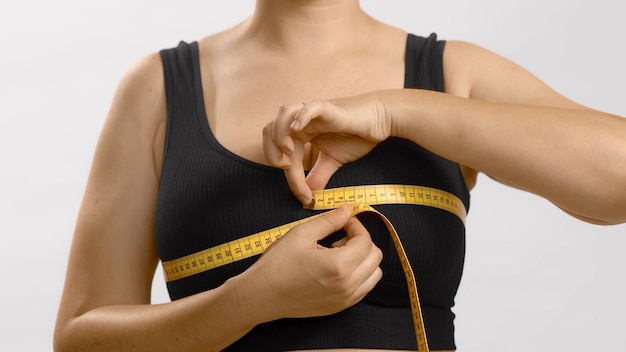
Before surgery, we recommend that breastfeeding has been completed and that breast size and body weight are stable.
Breast Lift and Augmentation After Weight Loss
After significant weight loss, the breasts can lose a large part of their fat tissue while the skin remains stretched. This can result in empty, elongated and markedly drooping breasts.
The lift removes excess skin and reshapes the remaining tissue, while the implant recreates suitable volume and improves fullness in the upper part of the breast.
In cases of very thin tissue, the result can also be complemented with the patient's own fat.
Recovery After a Breast Lift and Augmentation
After surgery, swelling, bruising, a feeling of tightness and moderate tenderness are expected. Since the procedure involves both a lift and an implant, the feeling of tightness may be somewhat more pronounced in the first few days.
After surgery, we recommend wearing a special supportive bra that supports the breasts and reduces implant movement during healing.
Most patients can return to lighter everyday activities after approximately one week. In the first few weeks, the following should be avoided:
- lifting heavy loads
- intense exercise
- sudden arm movements
- sleeping on the stomach
- significant strain on the chest muscles.
We encourage walking soon after the procedure. Returning to work depends on the type of work, while sporting activities are introduced gradually according to our instructions.
When Is the Final Result Visible?
The change in breast size, position and shape is visible immediately after surgery. Initially, the breasts are swollen, firm and positioned slightly higher.
Over the following weeks and months:
- the swelling gradually subsides
- the tissue softens
- the implants settle into their position
- the lower part of the breast takes on a more natural shape
- the scars begin to fade.
A first, more realistic assessment of the shape can be given after a few months, while the final result is usually assessed at around six to twelve months.
The result is long-lasting, but the breasts remain subject to ageing, gravity, skin quality, pregnancy and fluctuations in body weight.
Lift and Augmentation, or Breast Lift Alone?
A standalone breast lift is suitable when the patient is happy with her breast size and has enough of her own tissue. It improves position and shape, but does not add a significantly larger volume.
A lift combined with augmentation is recommended when, in addition to a higher position, the patient also wants:
- larger breasts
- a fuller upper breast
- more pronounced projection
- to make up for lost volume.
Lift and Augmentation, or Breast Augmentation Alone?
Standalone breast augmentation is suitable when the nipples are not significantly dropped and there is no significant amount of excess skin.
If the breasts are sagging, an implant alone can increase volume, but it cannot always create a suitable nipple position and a taut skin envelope. In such a case, a lift is also needed for a well-proportioned result.
Individual Consultation
During the consultation, we assess:
- the size and shape of the breasts
- the degree of sagging
- the position of the nipples and areolas
- the amount of the patient's own tissue
- the quality and elasticity of the skin
- the width of the chest
- any asymmetry
- the desired breast volume and shape
- your expectations.
We carry out precise measurements and, together with you, choose the most suitable implant size, shape and position. We also explain the course of the scars and assess whether the procedure can safely be performed in a single operation or whether a two-stage approach is more suitable.
Frequently Asked Questions
Augmentation mastopexy is a combination of a breast lift and breast augmentation. During the procedure, we remove excess skin, lift and reshape the breast, and add volume with an implant.
Yes. In most suitable patients, both procedures can be performed at the same time. In cases of significant sagging, poor skin quality or more demanding anatomical conditions, we may recommend performing the procedure in two stages.
Not always. A larger implant increases volume, but it does not remove excess skin or reposition a nipple that sits too low. In cases of more pronounced sagging, a lift is also required.
The size is chosen based on the width of the chest, the amount of the patient's own tissue, skin quality, the degree of sagging and the desired result. In augmentation mastopexy, we often recommend a moderate volume, which places less strain on the lifted tissue.
The term Preservé™ mastopexy describes a combination of a breast lift and augmentation using the tissue-sparing Preservé™ technique. With the Preservé™ technique, we create the pocket and insert the implant, while the mastopexy removes excess skin, reshapes the breast and lifts the nipple.
No. Preservé™ allows for a less invasive approach to implant placement, but in sagging breasts the surgeon still needs to remove excess skin. The mastopexy scars therefore depend on the degree of sagging, not on the method used to place the implant.
No. Suitability depends on tissue quality and thickness, the degree of sagging, chest anatomy and the desired breast size. This is decided after measurements and a clinical examination.
Yes. A breast lift cannot be performed without removing skin and making surgical incisions. The course of the scars depends on the degree of sagging. Scars generally fade over time.
The patient's own fat can be used to complement the implant, improving transitions, covering edges, filling minor irregularities, or improving asymmetry.
In patients who want a smaller augmentation and have enough fat available for harvesting, this is possible in certain cases. In cases of more significant volume loss or a desire for a larger augmentation, implants are generally more suitable.
For office and lighter work, a return is often possible after approximately one week. Physically demanding work requires a longer recovery.
A special supportive bra usually needs to be worn for several weeks. The exact duration is adjusted to the extent of the procedure and the course of healing.
Breastfeeding is possible for some women after the procedure, but it cannot be guaranteed, so we advise deciding on the procedure after you have finished planning your family.
The body's natural ageing continues after surgery. The result can be affected by skin quality, implant size, pregnancy and significant fluctuations in body weight. Choosing a suitable implant and maintaining a stable body weight can help preserve the result for longer.
Breast implants do not need to be automatically replaced after a predetermined number of years. Replacement is needed if a problem arises, the breast changes, or the patient wants a different size or shape. In any case, we recommend regular clinical and imaging check-ups and participation in early breast cancer screening programmes.