Facelift: a comprehensive guide for anyone considering facial rejuvenation
Ljubljana, 30.11.2025

When the skin on the face starts to change, most patients first think of creams, skincare and less invasive treatments. Up to a point, that approach helps. Then comes a period when these methods simply aren’t enough. Facelift is a surgical procedure that improves sagging skin, loss of volume and laxity of the lower face and neck. The results are natural, long-lasting and key to restoring a youthful facial structure.
This article takes you from the first signs of ageing, through deciding on the procedure, types of facelifts, recovery and scars. The aim is simple: to understand what a facelift is and who it can truly help.
The first signs that the skin has lost firmness and when to consider a facelift?
Age-related changes do not happen overnight. We often notice them gradually:
- The skin on the cheeks becomes thinner and less tight.
- Facial contours are less defined, the jawline loses sharpness.
- The cheeks sag and create an impression of “tiredness”.
- Nasolabial folds (from the nose towards the mouth) become more pronounced.
- The skin under the chin becomes lax, a double chin appears.
- Sagging of soft tissues changes the shape of the lower part of the face.
- Loss of volume causes “emptier” cheeks.
- Make-up settles into fine lines more than before.
- Elasticity decreases regardless of skincare.
- You look tired even though you feel well.
If you notice several of these signs and they bother you to the point that you want a more lasting result, a facelift is one of the most effective methods. Creams and non-invasive treatments can improve the surface of the skin, but they cannot lift the elongated and sagging structures beneath it.

Are you considering a facelift?
At a consultation, we will explain in detail which method is most suitable for you, what results you can realistically expect and how recovery works.
How loss of cheek volume affects an aged appearance and how a facelift corrects this?
A face looks young when the cheeks are full, the skin is tight and facial lines are clear. When fat pads move downwards and the skin loses support, the whole face looks longer, narrower and tired. Loss of cheek volume also affects the lower face, where pronounced laxity can develop under the jawline.
A facelift works on two levels:
- it lifts subcutaneous structures (the SMAS layer), creating a natural result,
- it tightens the skin without an overly tight appearance.
A lift does not “change the face”, it restores the natural proportions you had years ago.
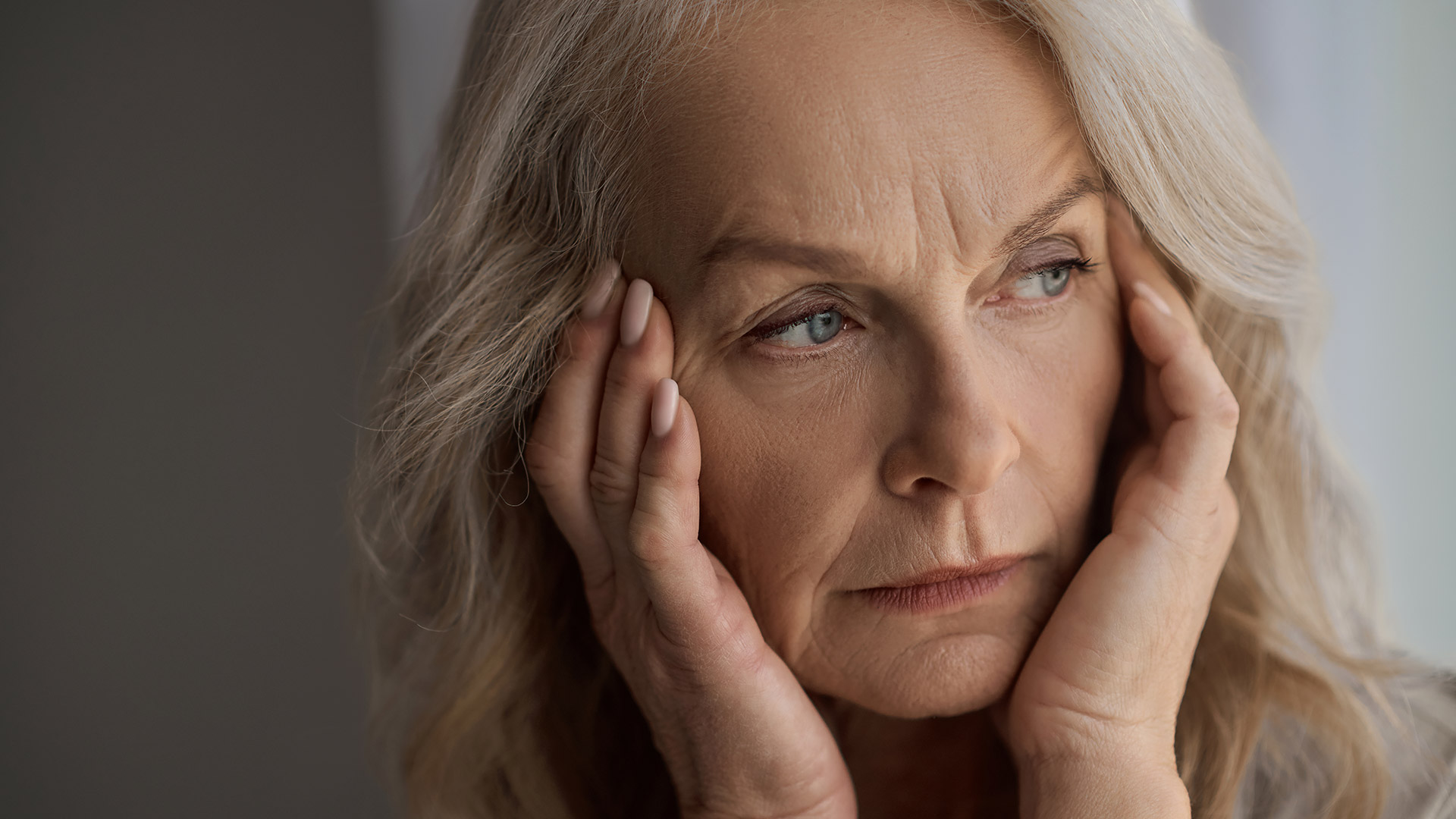
Why does facial skin sag at all?
Ageing is a combination of several factors:
- loss of collagen and elastin
- movement of subcutaneous fat pads
- weakened tone of muscles and ligaments
- the weight of the skin and gravity
- genetic factors
With early signs, non-invasive treatments can help, such as microneedling, radiofrequency, CO2 laser, mesotherapy or fillers with hyaluronic acid. But when sagging is more pronounced, no skincare and no non-invasive treatment can restore structure. At that point, a facelift becomes the most logical solution.
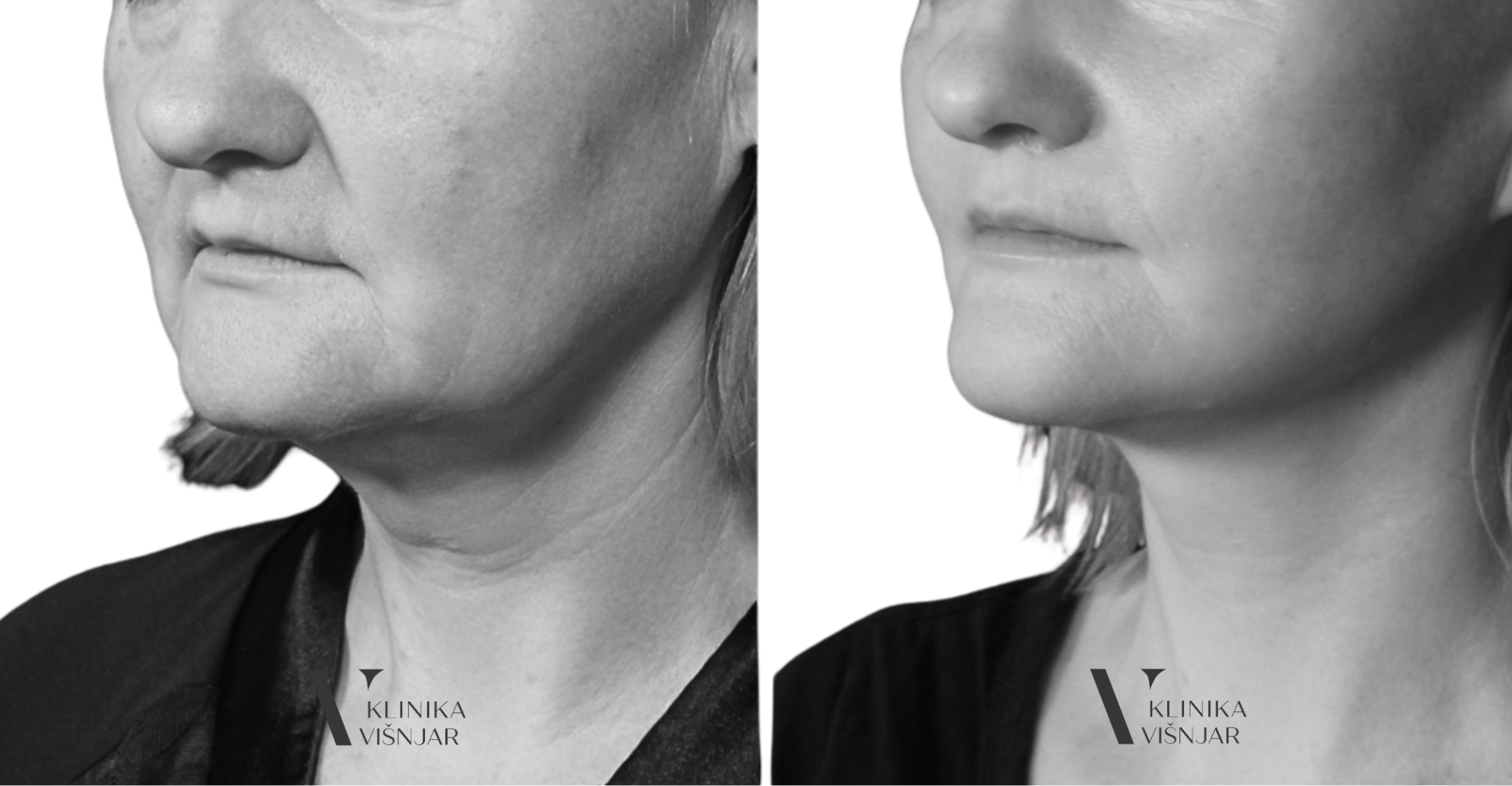
Facelift shown before (left) and after surgery (right).
What types of facelift exist (and which would be suitable for you)
A facelift is not a single procedure, but an umbrella term for several surgical techniques with which the surgeon lifts and reshapes deeper facial structures and the skin. At Klinika Višnjar, we most often perform an SMAS facelift, and for more extensive changes also a deep-plane facelift. Less extensive versions are also available, such as the mini facelift and S-lift.
Classic (SMAS) facelift
An SMAS facelift is a modern version of the “classic” facelift. The SMAS is the muscle-connective layer under the skin that supports the face. During this procedure, the surgeon:
- lifts and reshapes the SMAS layer,
- fixes it in a higher, more youthful position,
- only then gently adjusts the skin, without excessive tension.
The result is a natural lift of the cheeks, jawline and lower face, without the “pulled tight” look that was typical of older techniques where mainly the skin was tightened. An SMAS facelift is suitable for women with moderate to more pronounced signs of ageing, where the cheeks sag, the jawline is no longer clear, and there is laxity in the neck.
Deep-plane facelift
A deep-plane facelift is a more advanced, deeper technique for lifting the face. With this method, the surgeon separates not only the skin and SMAS, but also the layer beneath the SMAS and moves together:
- the skin,
- the SMAS layer,
- deeper fat pads and the soft tissues of the face.
Important connective “ligament” attachments are released as well, which allows the tissues to be repositioned more freely and naturally back to a position closer to a youthful appearance.
In practice, this means:
- a more pronounced effect on the midface (cheeks, nasolabial folds),
- better definition of the jawline and neck,
- less tension on the skin, so scars are usually less visible,
- typically a longer recovery and a technically more demanding procedure.
A deep-plane facelift is usually suitable for women with more pronounced signs of ageing, where an SMAS lift alone would not be enough for the desired effect, especially if the folds between the nose and mouth are markedly deep and the cheeks are strongly sagging. The effect of this procedure is long-lasting. It is often combined with a neck lift (neck lift) and other procedures.
Mini facelift
A mini facelift is a less extensive version of a facelift with smaller incisions and a limited extent of lifting. It is primarily intended for:
- early signs of sagging,
- improving an initially sagging jawline,
- a discreet “refreshing” effect.
Recovery is usually shorter than with a classic or deep-plane facelift. It is suitable for women who notice changes but do not yet have very pronounced skin laxity.
S-lift
An S-lift is a special form of mini facelift in which the incision is shaped like the letter “S” around the ear. This primarily lifts:
- the lower part of the cheeks,
- the jawline,
- initial laxity in the under-chin area.
It is used in patients who want improvement of the lower face, but do not yet have changes so advanced that a more extensive SMAS or deep-plane facelift is required.

Neck lift
If laxity is present mainly in the neck (so-called “turkey neck”, pronounced folds, double chin), a neck lift can be performed, often in combination with a face lift. With this:
- the skin of the neck is tightened,
- the transition between chin and neck is improved,
- the appearance of sagging and age-related “crêpiness” of the neck is reduced.
Combined procedures
For the most natural result, a facelift is often combined with other procedures:
- blepharoplasty (upper eyelid correction and lower eyelid correction),
- a ,
- lipofilling (your own fat for fuller cheeks and better volume proportions),
- CO₂ laser or other treatments to improve skin quality and structure.
Which technique is most suitable for you is not a matter of choosing “from a menu”, but depends on:
- the anatomy of your face,
- the degree of age-related changes,
- the desired effect and your readiness for recovery.
We make the final decision together at the consultation, where we consider your wishes and answer all questions. Book a consultation.

What is an S-lift and who is it intended for
An S-lift is a smaller, more targeted facelift. It enables:
- lifting the lower part of the cheeks,
- improving the line of the lower jaw, the jawline,
- subtle rejuvenation with a natural result.
It is suitable if:
- you are in your 40s–50s,
- you have early sagging and loss of tone,
- you want a less aggressive procedure and shorter recovery.
But it is not the best choice if the changes are already pronounced and you need lifting of the deeper tissues, the SMAS structures.
When is it most sensible to have a facelift?
A facelift is not tied to a number, but to the condition of the skin. The average age of patients is between 45 and 65. Key factors are:
- sufficiently elastic skin,
- clearly present signs of sagging,
- realistic expectations.
Patients who decide earlier (40s–50s) often achieve the most natural and long-term result because the changes are easier to manage.
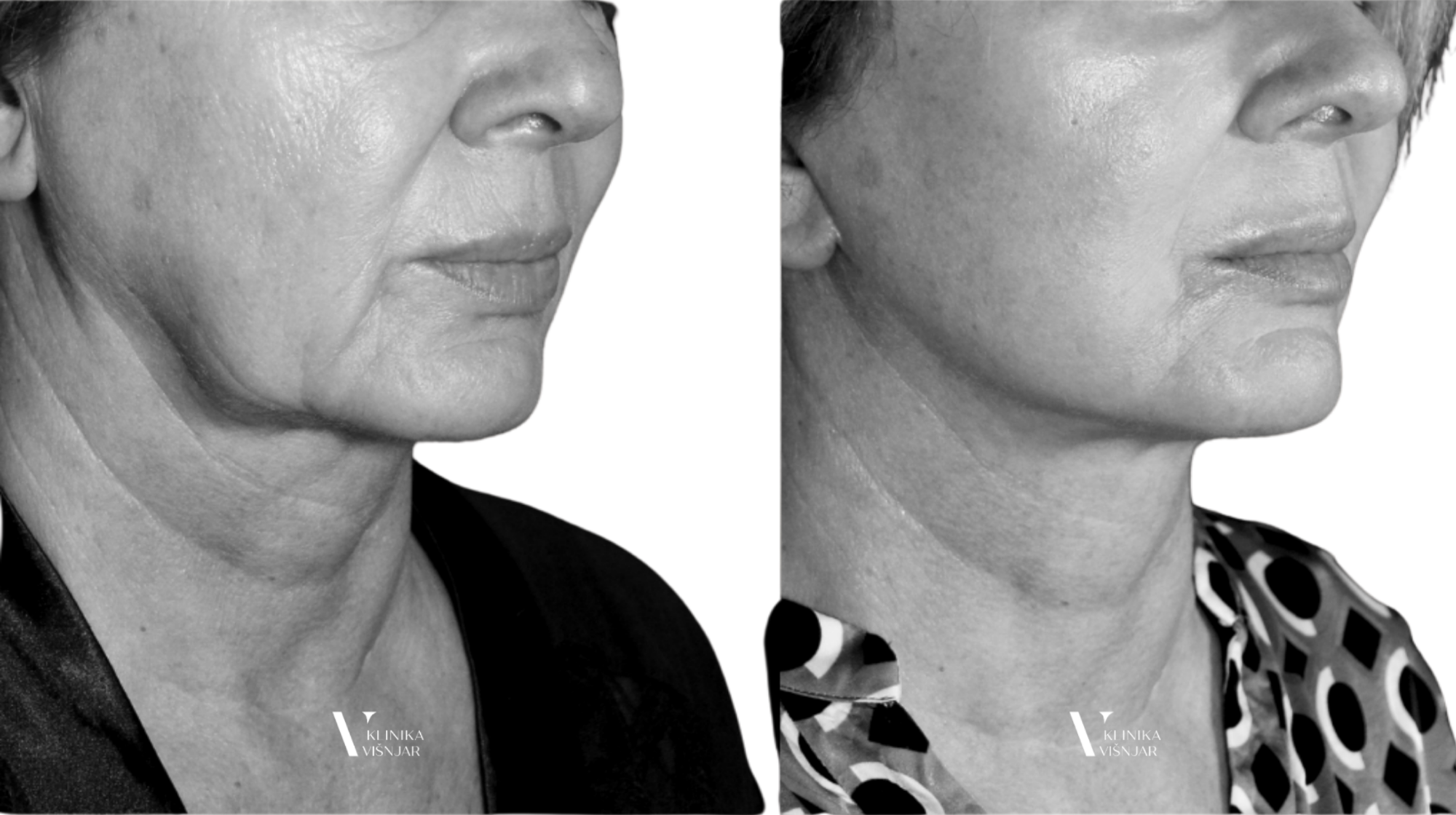
Facelift, shown before (left) and after surgery (right).
Celebrity facelifts
Although a face lift is often talked about quietly, there are quite a few celebrities who have spoken about it publicly. Open discussion helps the procedure no longer be seen as a “taboo”, but as one of the options for a well-groomed, youthful appearance.
- Jane Fonda, one of the most recognisable Hollywood actresses, has openly said in interviews that she had a facelift. She added that she is not proud of it, but does not hide that she chose the procedure because she wanted to look more rested and younger.
- Kris Jenner, the mother of the famous Kardashian family, even showed her facelift on a reality show. She has said several times that the operation is part of feeling well-groomed and confident even after turning 60.
- Dolly Parton is known for speaking very directly about aesthetic procedures. She has admitted multiple times that she has had, among other things, facelifts and sees them as a way to maintain an appearance she feels good in.
- Sharon Osbourne is another example of a celebrity who is very open. She spoke critically about her most recent facelift and said she was not satisfied with the result. This is a good reminder of how important surgeon choice and realistic expectations are.
- Marc Jacobs, a fashion designer, is one of the few men who publicly announced he had a facelift. In 2021 he decided on facial rejuvenation, and after surgery he updated his fans daily on recovery. He has said multiple times that he is extremely satisfied and recommends it to anyone considering it.
Why is this important for you? Not so you compare yourself to celebrities, but because it shows that a facelift is a widespread and normal procedure. The key is that you choose it for yourself, not because of your environment and not because of “fashion trends”.
How long recovery takes and what it looks like
Recovery happens gradually:
- first few days: swelling and a feeling of tightness,
- 10–14 days: most patients already look acceptable,
- 3–6 weeks: most swelling disappears,
- 3–6 months: final result.
Returning to work is possible after about two weeks, while exercise and physical activity come a bit later.
At Klinika Višnjar, we guide you through the whole process precisely, safely and kindly, so you are under professional supervision at every step and without worry.
Do scars after a facelift disappear quickly?
Surgical incisions are placed along the hairline border and around the ear, where they are discreet and gradually fade. In most patients, scars are barely noticeable after a few months.
To support faster healing:
- proper scar care,
- avoiding sun in the first months,
- good skin regeneration (by agreement, CO₂ laser or other therapies).
Patient experience: “I see myself again as I feel.”
Below is an example of a story we often hear during a consultation for a face lift. Names and details are adjusted for privacy, but the feeling is very real and typical for patients who decide on a facelift.
“I am 54 and everyone kept telling me that ‘for my age, I look great’. But every morning in the mirror I was met by a face that was no longer mine. My cheeks had sagged, my cheekbones had disappeared, and I always looked tired, even when I had slept well.
I admit I was afraid of a facelift. First because of the operation itself, and even more because I might no longer be recognisable. At the consultation at Klinika Višnjar, the surgeon explained very precisely what I could expect, what result was realistic and what recovery would be like. After the conversation, I felt for the first time that I had things under control, not that I was ‘going into something unknown’.
The first few days after surgery I was swollen and a bit scared whether everything would really be as we had discussed. After two weeks, I put on make-up for the first time and went for coffee with a friend. She only said: ‘You look rested. Have you been on holiday?’ That was the moment I knew the decision was right.
Today I do not look like ‘a different person’. I look like I’ve taken a few years back. The biggest difference is that I like looking in the mirror again, and my face matches how I feel inside.”
Stories like this show well that a facelift is not meant to turn you into a different person. The goal is that your face again reflects the energy you have, and that you feel calm and confident in your own skin.
Is facelift a procedure for you?
If sagging skin, loss of volume and an unclear jawline bother you, and you want a long-lasting, natural result, a facelift is one of the most proven solutions. Modern approaches, such as those performed at Klinika Višnjar, deliver very natural results that do not change your identity, but restore a youthful facial structure.
If you are still researching or you are right before deciding, you can read more about the procedure here. There you will find more details about methods, the course of the procedure and a results gallery.